


The Future of Fencing Arrives in Hunt Country
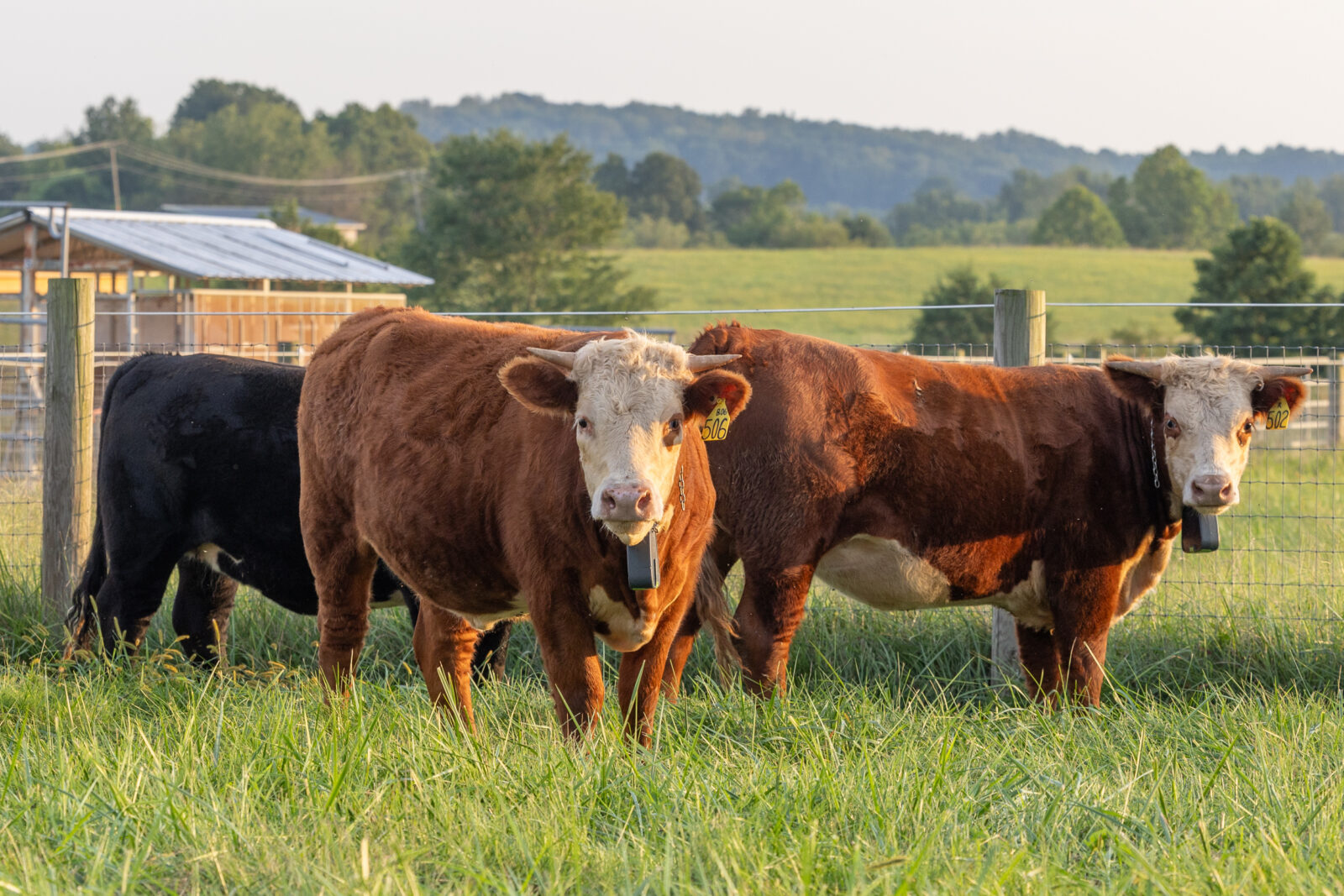
Virtual fencing offers a high-tech solution rooted in traditional land stewardship.
Story by Camden Littleton
On rolling pasture in Virginia’s Piedmont, a herd of cattle grazes peacefully. No reels of polywire stretch across the field, and no obvious barriers dictate where the animals can and cannot go. Yet the cattle remain exactly where they’re supposed to be.
At the Virginia Tech Middleburg Agricultural Research and Extension (MARE) Center, superintendent Tait Golightly has spent the last 18 months testing virtual fencing technology, an innovation that replaces physical interior fences with GPS-enabled collars and digital boundaries. What began as a research project funded through an internal grant from Virginia Tech’s College of Agriculture and Life Sciences is quickly proving itself as a practical tool with far-reaching implications for farmers, conservationists, and landowners alike.
“We were one of the first research stations in Virginia to start looking at this technology,” Golightly says. Today, approximately 200 collars are being used at other research stations around the state.
The GPS collar communicates with satellites and a smartphone or desktop application. Producers draw a virtual boundary on a digital map, and the collar does the rest. As an animal approaches the invisible line, it first hears an audible warning. If it keeps going, the collar delivers a brief electrical pulse like an electric fence.
“The remarkable thing is how quickly they learn,” Golightly says. “Most mature cows understand and respect the boundary within a week.” Cattle are naturally herd-oriented, and once the herd understands the boundary, compliance tends to follow. However, there are occasional exceptions.
Golightly laughs when describing one particularly independent cow. “She’s a loner,” he explains. “She doesn’t always respect the virtual fence. She’ll wander off, lie down somewhere by herself, and then eventually come back.” Fortunately, the collar also provides real-time location tracking.
The MARE Center currently uses the collars on approximately 20 cattle and recently expanded the project to include 25 sheep. Interestingly, the sheep have adapted even faster than the cattle. “Once they learn where that boundary is, they don’t seem interested in testing it again,” Golightly says.
While the technology itself is impressive, its greatest value may be what it allows producers to do with their time. Before implementing virtual fencing, Golightly’s staff routinely moved temporary fencing every day to maintain intensive grazing rotations. Now those same pasture shifts can be accomplished with a few taps on a phone screen.
“We’ve seen about an 80% reduction in labor from a grazing management standpoint,” Golightly estimates. “I can move cattle to fresh grass in two minutes from my phone.”
That flexibility has practical benefits beyond saving labor. If a veterinarian visit, a family emergency, or another farm task interrupts the day, pasture rotations no longer wait until someone can physically walk fence lines across the property. And for producers managing multiple rented farms or noncontiguous parcels, the advantages become even more significant.
Tim Mize, Virginia Cooperative Extension’s agriculture and natural resources agent in Fauquier County, sees that adaptability as the technology’s greatest strength. “It’s another tool that can make rotational grazing more practical and manageable.”
The technology also opens intriguing possibilities for conservation. At the Middleburg center, researchers are exploring how cattle and sheep can be used as precision management tools within wildlife habitat areas, native grass plantings, and pollinator plots. Virtual boundaries can keep livestock away from sensitive wildflower patches, ground-nesting bird habitat, or potentially toxic trees, all while still utilizing the surrounding acreage.
The approach offers an unusual combination of agricultural productivity and ecological stewardship. Rather than disrupting the landscape with physical fences, managers can guide animals exactly where grazing pressure is needed — and remove them just as easily.
In Hunt Country, where open vistas and historic landscapes are part of the region’s identity, the technology presents another appealing advantage. “Sometimes we want to maintain that landscape view without physical fencing and barriers,” Golightly says. “Virtual fencing allows us to manage grazing while preserving those aesthetics.”
Though collars generally cost between $250 and $300 per animal, USDA cost-share programs have begun helping producers offset some of the expense. Golightly estimates long-term costs at roughly $40 to $45 annually per mature cow, spread over the animal’s life.
Neither Mize nor Golightly believes traditional fencing will disappear entirely. Yet both see virtual collars becoming a useful part of the agricultural landscape.
“I think virtual fence collars are going to become a much more common, and eventually dominant, fencing tool for cattle producers,” Mize predicts. “I don’t think they’ll replace every fence, but as the technology improves and producers become more comfortable with it, I can see virtual fencing becoming a normal part of how we manage cattle and pasture, just like electric fencing is today.”
For now, the invisible fence remains a novelty that stops visitors in their tracks. But out in Virginia pastures, where technology and tradition are meeting more regularly, a simple collar may be quietly redrawing the boundaries of modern agriculture. ML
Published in the November 2026 issue of Middleburg Life.