


Best Practices to Protect Local Waterways
Written by Sarah Hickner | Photo by Hugh Kenny
Water carries life, but it can also carry disease and impurities. The primary goal of Fauquier County’s John Marshall Soil and Water Conservation District is to protect the water quality of the Chesapeake Bay watershed and the streams that feed into it. The organization works with local farms, using grants to subsidize conservation efforts that help keep livestock, property, and water sources safe.
That means farm owners can help the environment and their animals with relatively little out-of-pocket cost. District Manager Melissa Allen says, “We are grateful for the opportunity to work with landowners and farmers to improve soil health and water quality. Each site visit is an opportunity to educate and to learn.”
Fencing Off Natural Water Sources
The JMSWCD has a cost-share assistance program to help farm owners with the expense of fencing off natural water sources. Many landowners rely on streams and ponds to provide water for their animals, but drinking directly from these sources can introduce both short- and long-term health risks.
Diseases can spread through streams due to fecal contamination from wildlife and livestock. Leptospirosis thrives in standing water and can cause miscarriages in cattle and horses. It has also been linked to recurrent uveitis in horses. Bacteria such as salmonella and E. coli can be picked up in contaminated water and spread rapidly through herds. Even equine protozoal myeloencephalitis is caused primarily by Sarcocystis neurona, a parasite spread through feed or water contaminated by opossum waste.
Despite these risks, natural water sources are often seen as assets because they provide animals with constant access to water. The JMSWCD understands this reality and works with farm owners to find safer solutions.
Grants are available to help landowners offset the cost of fencing off natural water sources from livestock and horses at a rate of $7.50 per foot of fencing. While that amount may not cover the cost of a traditional four-board fence, it can significantly reduce the expense of protecting both animals and waterways. The organization can also assist with installing watering systems in fields where natural water sources have been fenced off.
Creating a Buffer
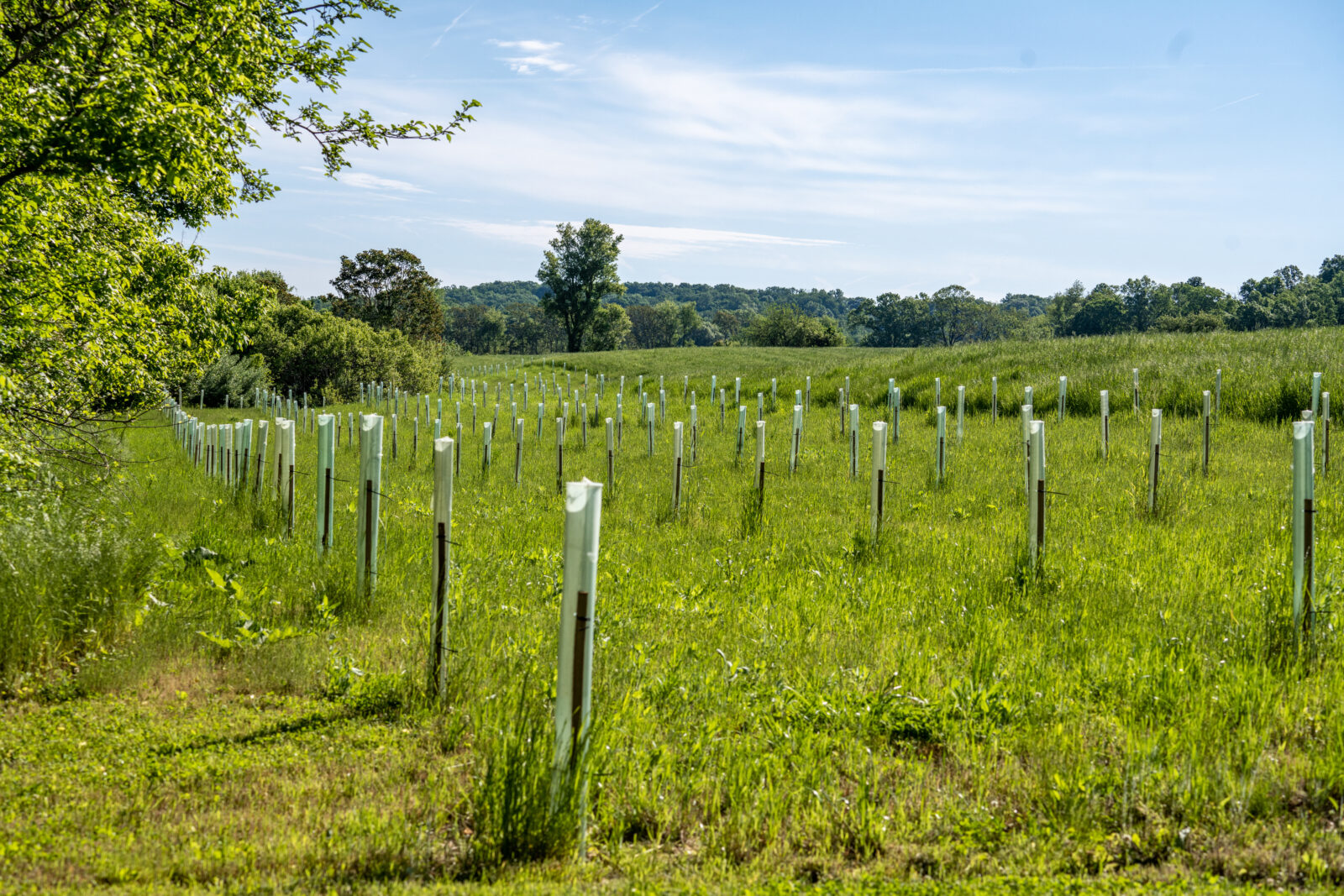
Another way to improve the safety and purity of the local watershed is by creating a natural tree barrier known as a riparian buffer.
When rain falls on pastures or cropland, it rarely soaks straight into the soil. Instead, it moves across the land, carrying soil particles, manure, bacteria, and fertilizer nutrients such as nitrogen and phosphorus. If there is no vegetation along a stream bank, that runoff can move quickly and directly into the water.
A tree buffer helps slow this process. Leaves and undergrowth reduce the speed of surface flow, allowing the water to spread out instead of channeling toward the stream. As the water slows, sediment settles out before it reaches the waterway.
Tree roots also help filter pollutants and stabilize stream banks. In this way, a riparian buffer becomes a natural filtration system that protects both land and water.
The JMSWCD covers 95% of the approved cost of planting a riparian buffer, and a grant from the Piedmont Environmental Council can often cover the remaining expense. “We are very fortunate for the working partnership with PEC and its staff, and its role in encouraging landowners to plant riparian buffers,” Allen says.
Bin-Style Composting
There are also funds available to help farms in the Goose Creek watershed establish composting systems. When managed properly, a compost pile becomes its own small ecosystem. The heat generated inside reduces harmful bacteria while destroying parasite eggs and weed seeds.
Over time, manure breaks down into dark, crumbly compost that can be returned to the soil. Instead of washing into nearby waterways during storms, nutrients are recycled into the pasture where they support healthy grass growth.
Rotational Grazing in Pastures
Pasture management is another important piece of protecting local water sources. When livestock repeatedly graze the same plants before they have time to regrow, the roots weaken and the soil begins to break down. This can lead to bare patches, weed growth, and increased runoff of manure into nearby streams.
Healthy grass with strong root systems helps hold soil in place and absorb rainfall. Overgrazed pastures, by contrast, shed water more quickly, increasing erosion and nutrient runoff.
Rotational grazing helps address this problem by giving pastures time to recover. When animals are moved between grazing areas, the grass can regrow its leaves and rebuild its root system. Stronger roots create more stable soil and help the ground absorb and retain water. “Rotational grazing is the icing on the cake after infrastructure changes have been made,” Allen says.
The JMSWCD works with farm owners to create plans that allow pastures adequate rest between grazing periods. Landowners can receive $75 per rested acre through this program, and many use those funds to improve fencing or reseed.
Protecting our waterways does not require sweeping change so much as steady stewardship. Fencing livestock out of natural springs and ponds, planting tree buffers along streams, composting manure, and allowing pastures the rest they need are practical steps that make a lasting difference.
Through cost-share programs, technical guidance, and on-the-ground support, the John Marshall Soil and Water Conservation District is helping local landowners strengthen their farms while safeguarding the health of the Chesapeake Bay watershed. In the end, these efforts protect more than water quality; they preserve the soil, keep our horses and livestock healthy, and ensure the long-term resilience of the land that sustains both people and animals.
For more information, Fauquier County residents can contact the John Marshall Soil and Water Conservation District at (540) 422-8490, and in Loudoun County, contact the Loudoun County Soil and Water Conservation District at (571) 918-4530. ML
Published in the April 2026 issue of Middleburg Life.